
In the glassware industry, what decides whether a cup can be formed — and whether its dimensions stay consistent once formed — is often not the mould but the flame. The tube cutting, mouth rounding, bottom sealing, shaping, spout pressing, handle attaching, rim cutting and rim grinding stations of a glass cup line all rely on gas and oxygen burned to a high temperature that softens borosilicate glass into shape — on the order of several hundred degrees Celsius, giving the material enough fluidity to be formed within seconds to a few minutes. The temperature window is narrow: if the flame surges and sags, the rim goes out of round, the wall thickness varies, and the base does not seal cleanly.
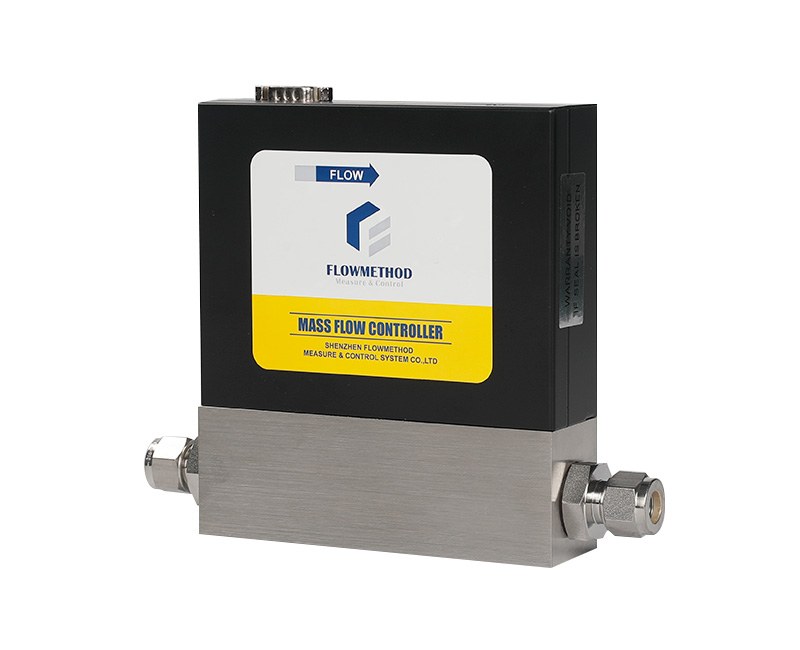
Flame stability therefore becomes the lifeline of the line, and flow control stops being an auxiliary operation and becomes part of the process itself. In the glass processing equipment industry, Flowmethod gas mass flow controllers are already widely used, with precise two-channel mixing of methane and oxygen at the core.
1. The old process: needle valves and gas cylinders, with stability tied to tank pressure and feel
- Mixing by manual needle valve: the gas and oxygen were traditionally adjusted by hand, with the operator turning a needle valve to set the flame. Valve opening and flow are not linearly related, so calibration is difficult and repeatability is poor — the same valve position gives a different flame in a different batch and in a different pair of hands.
- The gas supply was cylinders: most lines ran on bottled gas. Cylinder pressure keeps falling as gas is consumed, so the actual flow at the same valve position drifts down, the flame gradually weakens, and the operator has to compensate by feel. When the line gets busy, that compensation is the first thing to get missed.
- Keeping the flame steady was down to a person watching it: softening and forming of a glass cup demand a very stable flame, and the old process loaded that responsibility onto the experienced operator on the line — when to open the gas up, when to close it back down, when to shut it off immediately were all decided by feel.
- The cost is very concrete: such master operators are scarce and take a long time to train, labour cost is high, and there is a clear succession gap — the craftsmen who can hold a steady flame are steadily fewer, and new hands need long hours of practice before they are trusted with the line. Product consistency is clearly affected by the person's condition, dimensional spread within one batch is hard to bring down, and the line's takt and output are capped by the availability of people rather than by the process.
2. After automation: two flow controllers take the flame out of the operator's hands
More and more glass cup lines now use gas mass flow controllers for precise methane and oxygen mixing: one channel for fuel gas, one for oxygen, each supplying to its own setpoint, combined into the burning mixture at the process ratio and delivered to the burners of each station. Flow changes from "somebody turns a valve" to "gas is supplied to a setpoint", and flame stability no longer depends on who is operating the line or how much gas is left in the cylinder.
- The dependence on operators is removed: ignition, shutoff, high flame and low flame at the critical stations are executed by programme against the process takt, so the master operator shifts from "the person who must watch the line" to "the person who sets and tunes parameters".
- Consistency improves clearly: repeating the same setpoint under the same conditions no longer lets the gas-to-oxygen ratio drift with handling, so the consistency of rim, wall and base forming improves visibly.
- Throughput and capacity are released: the takt is now set by the process rather than by waiting for an experienced operator to be in place, and staff can move from operating several stations to centralised monitoring and die changeover.
- Variation becomes traceable: setpoints and actual gas supply can be recorded and compared, so process parameters can settle into standard recipes instead of living in individual experience.
3. This process places two special demands on the flow controller
1. Fast response: open, shut, up, down — in a hurry
The station takt of a glass cup line is not long: depending on the station, a single heat runs from tens of seconds to a few minutes, and during forming the flame also has to be turned down at any moment, or shut off immediately in the event of an abnormality. A flow controller therefore has to be not only steady but fast.
- The Flowmethod FL-802 / FL-803 / FL-805 series gas mass flow controllers have a 1 second response time and a 1–100% control range.
- That makes "fast on, fast off, quickly larger, quickly smaller" workable on a second-scale takt: the station action and the flame action can be driven by the same programme along one timeline, instead of a person chasing them by hand.
2. Accurate mixing, with the medium difference taken into account
The fuel gas and the oxidiser used in glass plants are methane and oxygen, and neither of them is nitrogen. These products are calibrated on an equivalent nitrogen basis, so when methane or another fuel gas is used, the setpoint must be corrected with the conversion factor given by the manufacturer; the difference in the thermal properties of the medium itself also affects the actual flame.
- Setpoints must be converted for the actual medium: the conversion factor comes from gas physical properties (density, specific heat and so on) and differs markedly between gases — do not read an equivalent-nitrogen value directly as a methane flow.
- The oxygen side must be confirmed separately: oxygen is a strongly oxidising medium, so wetted materials, sealing and cleanliness requirements differ from the fuel-gas side, and the model must be confirmed with an engineer against the actual working conditions.
- Pressure and range are matched to the station: the Flowmethod FL-802 / FL-803 / FL-805 series covers equivalent-nitrogen ranges of 0–10 / 10–50 / 50–200 SLPM, with a 316L stainless steel body and several pressure configurations, so models can be selected against the actual gas consumption and line pressure of each station.
4. From "the person who watches the flame" to "the person who manages parameters"
Automation of the glass cup softening and forming process is not about replacing one station with a machine — it is about taking the stability of the flame out of human experience and handing it to repeatable flow control. The feel of the master operator is translated into setpoints and ratios and written into recipes and programmes; the scarcity of master operators no longer caps capacity directly, and product consistency no longer fluctuates with a person's condition.
If you run a glass cup line or a similar high-temperature softening and forming line and are evaluating a gas and oxygen mixing scheme, you can tell our engineers the medium, target flow, working pressure and station takt, and they will recommend the model and configuration for your actual conditions and confirm the conversion factor and wetted material compatibility. Shenzhen Flowmethod Measure & Control Systems Co., Ltd. — mass flow controllers and mass flow meters covering ranges from milliliters to hundreds of liters.
For selection, product documentation or technical enquiries, contact Shenzhen Flowmethod Measure & Control Systems Co., Ltd.:
Contact: Mr. Dou | Tel: +86-18038183381
Email: doufeijin@hotmail.com | Website: www.flowmethod.net