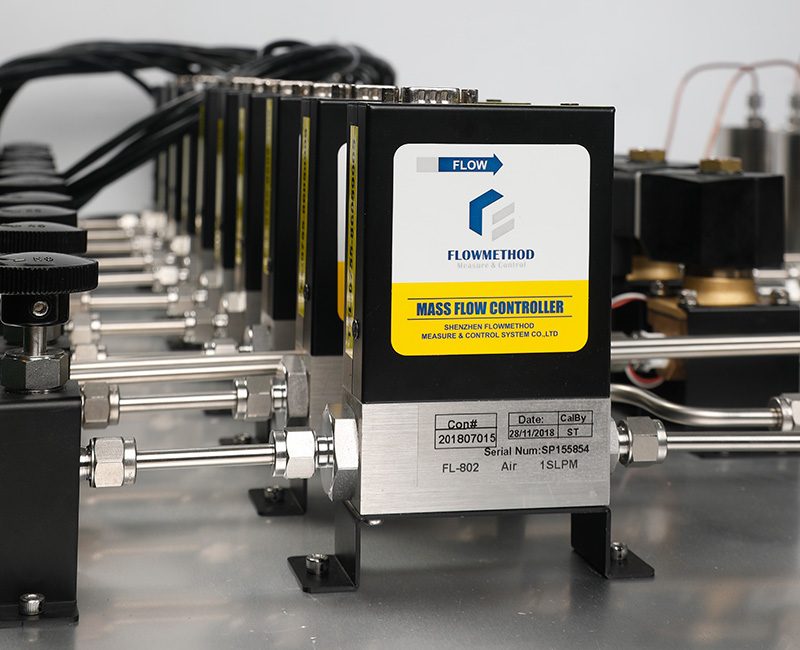
Gas mass flow controllers (MFCs) and mass flow meters (MFMs) can connect through analog signals, digital communication or a local display. The best option depends on existing hardware, how operators use the instrument and the total cost of the system. First confirm gas, range and pressure; then choose the interface that fits the application. Only an MFC regulates flow from a setpoint. An MFM measures and reports flow without an active control valve.
1. Analog interfaces
Analog instruments commonly use voltage or current signals. The current Flowmethod analog options are 0–5 V and 4–20 mA. Voltage interfaces are straightforward to wire, but cable length, ground voltage differences and interference can affect the received signal. Current-loop interfaces can be more suitable for long transmission distances and electrically noisy environments.
Check the actual input/output circuit, grounding and isolation requirements. Multiple receivers must be connected in the arrangement supported by their electrical specifications; do not assume every voltage output can drive any number of parallel inputs or every current loop can support multiple series receivers.
1.1 MFC with an FL-100 display instrument
A compatible FL-100 provides manual flow setting and real-time display. The combination is easy to use on a bench or desktop where operators do not need frequent or automated changes. Connect the agreed gas fittings and electrical equipment, then set and read flow locally.
Its limitation is that this standalone arrangement does not automatically change setpoints according to a process program. It is suitable for manual operation rather than an unattended recipe sequence. With a meter, the corresponding arrangement displays the measured flow and does not set it.
1.2 MFC with a PLC or data-acquisition card
Many industrial systems already contain a PLC, a DAQ or a custom acquisition board. These resources can send a setpoint to a controller and read its feedback, allowing software to adjust flow in line with the production process. For a meter, only the input channel needed to read flow is used.
Using existing hardware can keep instrument costs low and enable automation. However, each analog instrument generally requires dedicated input/output resources. This is convenient for a few channels; a system with dozens of instruments may need expensive additional modules and more wiring.
Time-sharing analog channels can reduce hardware requirements, but it trades away update speed. Setpoint multiplexing also needs an appropriate way to retain independent outputs, which may add complexity and cost.
2. Digital communication
RS485 and Modbus RTU are widely used for connecting flow products to computers and industrial controllers. A software system can operate multiple devices on a shared communication bus, subject to compatible protocols, addressing and electrical limits.
Digital integration can reduce the number of dedicated analog ports, simplify wiring and support centralized monitoring. Compare the instrument price, control hardware, software integration and maintenance effort with the analog alternative. The best choice is the combination with the strongest overall fit, not necessarily the cheapest individual instrument.
3. Local display and keypad operation
An integrated-display controller, such as a CM-series unit, combines local readings and keypad settings with remote communication and analog interfaces. One instrument can therefore support independent desktop operation and later connection to a larger control system.
The display provides convenient information and avoids a separate readout instrument. Local and remote modes can suit different operating needs, subject to the model's supported functions. Integrated display typically costs more but offers flexibility. A CM-series meter displays flow locally and can transmit readings; it cannot regulate flow or accept a flow-control setpoint.
Choose the interface after the basic conditions
The interface is not the first selection decision. Once the gas, flow and pressure requirements are known, compare available hardware, update speed, manual or automatic operation, and total system cost. Choose the configuration that matches the actual application.
Flowmethod designs, develops, manufactures and supports gas mass flow controllers, meters and custom gas-control and mixing systems. Configurations are matched to the customer's process and operating requirements.
For selection, installation or technical enquiries, contact Flowmethod: Mr. Dou, +86 180 3818 3381; doufeijin@hotmail.com. See Contact for the full contact list.