
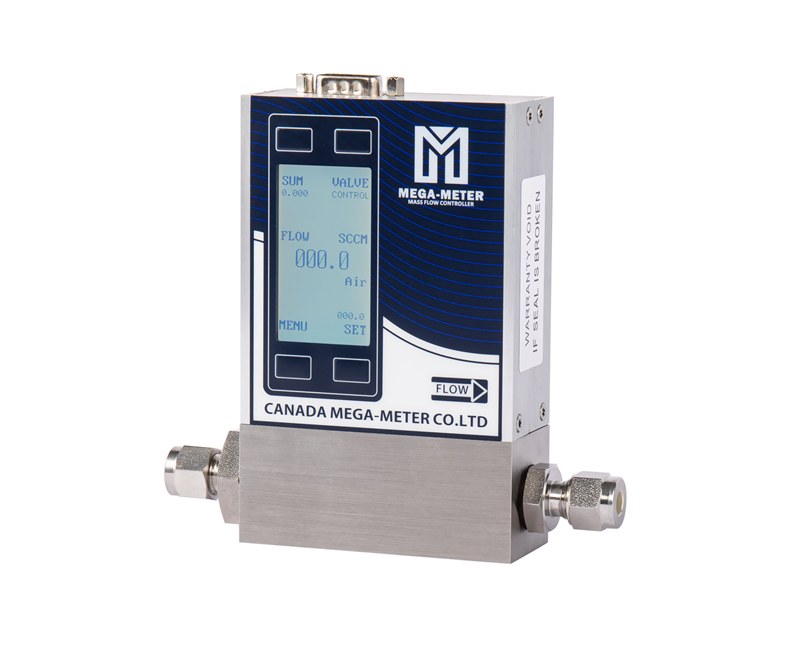
When an engineer sends in a requirement, pressure is often written as a single line: "inlet pressure 0.4 MPa". That one line actually hides at least four conditions that must be asked separately: is it gauge or absolute pressure? What is the range of inlet pressure? What is the outlet pressure, and is there back pressure? Will the unit ever run in vacuum?
If these are not separated, the selected model may not physically fit the line - or it may fit but never hold a stable flow. Far more often the model is perfectly adequate and the requirement was simply stated far too harshly, which means paying for capacity that is never used. Below is each condition in turn, followed by three mistakes that come up again and again.
1. Gauge or absolute: if the reference is wrong, everything after it is wrong
- Gauge pressure is measured relative to ambient: zero is atmospheric pressure, and a negative value means below atmospheric;
- Absolute pressure is the pressure of the gas itself: only zero is a true vacuum;
- Vacuum level is the difference between ambient and absolute pressure.
The relations are: absolute = ambient + gauge, and vacuum = -gauge. Take a number common in vacuum processes: a gauge reading of -0.09 MPa corresponds to an absolute pressure of about 0.0113 MPa at 0.1013 MPa ambient, roughly one ninth of atmospheric. The two differ by a full atmosphere, and confusing them puts the entire gas calculation off by an order of magnitude.
Always state the reference on the inquiry: if the instrument is specified in absolute pressure, specify absolute pressure. Entering a gauge value where an absolute value is expected means you are not measuring the condition you think you are.
2. Pressure rating and working pressure are not the same thing
The two terms are routinely used interchangeably in purchasing conversations, yet they constrain completely different things:
- The pressure rating is a structural limit - how much pressure the body, wetted path and valve can withstand without being damaged. It answers "how much force can this hardware take", and belongs to the specification checklist;
- The working pressure is a condition of use - the range over which the unit may be operated continuously. It answers "can the flow actually be controlled in this unit".
Two things are worth noting here. First, working pressure interacts with the medium: the gas may be incompatible with the seal material, and pressure conditions interact with temperature, so state the process temperature as well. Second, the inlet pressure range maps onto the pressure rating of the model, while the working pressure range maps onto whether the valve can open properly and hold the flow steady. These are two different sentences, and neither substitutes for the other.
Flowmethod FL series bodies and wetted paths are 316L stainless steel, the standard choice for common industrial gases. The specific pressure rating and working pressure range depend on the model and differ between models - confirm them against the datasheet for the configuration you are quoting.
3. Inlet pressure range: you need a band, not a number
A single inlet pressure value tells the supplier nothing. What the controller has to cover is a range: the lower limit determines whether the valve can still hold a controllable flow and response at the bottom of the range, and the upper limit has to sit within the pressure rating of the model.
Both ends matter: maximum working pressure and minimum working pressure. If the pressure moves in the field - an unstable gas supply, several users drawing from the same header - the swing has to be stated too, because the lower limit directly affects control performance at low flow.
There is also a point that gets missed: a wider inlet pressure range is not automatically better. A wide range means the valve and the seals have to serve both extremes at once, and control behaviour at the low end is harder to serve; longer range also means longer production and commissioning time on the manufacturing side. Selecting to the real duty point is cheaper than selecting for "wide coverage".
4. Outlet pressure and back pressure: the differential decides whether the valve can control at all
The outlet side needs the same treatment. State the range of outlet pressure, whether back pressure exists downstream (restriction in the downstream line, or a pressurised vessel downstream), and whether the outlet vents to atmosphere, is evacuated, or feeds directly into a process chamber.
The reason lies in the differential. A flow controller establishes flow by maintaining a controlled differential across the valve, and back pressure consumes part of the available differential: the higher the back pressure, the less differential is left for the valve at the same inlet pressure, the lower the achievable flow ceiling becomes, and the more the reading drifts from the setpoint as the pressure moves.
Back pressure has two common sources, and they need to be distinguished: friction in the downstream line (long pipe runs, elbows, filters, a blocked outlet) and downstream equipment that is itself pressurised (feeding into a pressurised chamber). The first can often be improved by line design; the second is fixed by the process.
The reverse case is a vacuum outlet: the outlet sits below the inlet, so the differential across the valve increases, which usually helps control, but makes the dead band and leakage in the low-flow range more sensitive.
That is why the inlet range and the outlet range belong on two separate lines of the inquiry form, with back pressure flagged on its own. Without both numbers, half of the information needed to select a model is simply missing.
5. Vacuum service: negative pressure is not "negative atmosphere"
Three things behave differently when the unit runs at negative pressure or close to vacuum:
1. Reference: on the vacuum side, gauge pressure is negative while absolute pressure is a small positive number close to zero. The two must not be mixed up.
2. The direction of back pressure changes: the outlet is no longer resisting against positive pressure; it sits below the inlet, so the differential relationship is the opposite of venting to atmosphere.
3. Micro-leakage is amplified: at atmospheric pressure a small leak accounts for a negligible share of the gas; under vacuum the same leak has a much larger effect on the chamber vacuum, because with finite pumping speed the leak itself sets the lowest pressure you can hold.
Vacuum service therefore cannot simply inherit conclusions drawn at atmospheric pressure. State whether the operating range crosses into vacuum, give the absolute pressure upper and lower limits, and specify whether non-return protection or a fill/purge arrangement is required.
6. Three pressure selection mistakes that keep coming back
Mistake 1: "a differential is enough"
The most common sentence is "inlet and outlet differ by 0.1 MPa". The problem is that a differential is only the difference between inlet and outlet; it says nothing about the absolute range of either.
Take the same 0.1 MPa differential in two situations: inlet 0.1 MPa venting to atmosphere, and inlet 5 MPa with the outlet at 4.9 MPa. The differential figure is identical, but the second case runs at fifty times the inlet pressure, and the two point at completely different models in terms of body, valve, sealing and commissioning.
It gets worse in the other direction: in vacuum or slightly-pressurised service, a first approximation is easily written as a negative number or simply guessed, and on paper the condition ends up looking "close enough" when it is not. A differential is not a selection criterion, and it cannot replace the absolute range of inlet and outlet.
Mistake 2: "wider is safer - just order the high-pressure version"
The reasoning goes: "if it can take high pressure it covers everything, so order the wide-range model." On cost, this logic runs backwards.
Working pressure range and cost are positively correlated. The wider the range, the more extreme the duty the valve and the seals have to accommodate, and the higher the material and machining precision required. Manufacturing commissioning time grows with the range as well - a wide-range model takes noticeably longer to commission and more labour, and costs more as a result.
"Wide coverage" also carries a price of its own: a model that has to serve both the high and the low end tends to handle the low end less well. If your duty sits in the 0.1-0.3 MPa band, a model rated to 5 MPa gives you nothing you will use, and buys you nothing in the way of steadier low-pressure control.
Select to the real working range, and spend the money on accuracy rather than on coverage. The extra pressure rating buys performance you will never draw on.
Mistake 3: feeding a high-pressure cylinder directly, with no regulator
Supplying gas from a high-pressure cylinder is common, particularly in laboratories and small stations. One practice inflates cost for no reason: connecting a full high-pressure cylinder straight to the flow controller with no regulator in between.
The reality is that cylinder pressures sit in the 15-20 MPa range when full, while the actual working conditions at these stations are typically 0.1-0.3 MPa - nearly two orders of magnitude apart.
Feeding the cylinder directly means the controller is specified for an inlet pressure far above anything the process will see, which is a completely unnecessary working pressure requirement. It narrows the set of selectable models, it raises the price (you are paying for a high-pressure section you will not use), and the requirement bought by "saving a regulator" is typically money thrown away.
Quote the inlet pressure range after regulation, not the cylinder pressure. The correct arrangement is cylinder → regulator → flow controller, with the regulated pressure range - and the downstream pressure swing from the regulator - written into the inquiry. Cylinder pressure is the cylinder's business, not the controller's.
7. Pressure conditions on the inquiry form (copy this)
| Item | Example | Note |
|---|---|---|
| Medium | Argon / argon + 5% H2 | Determines wetted material and seals |
| Inlet pressure range | 0.1-0.3 MPa (gauge, after regulation) | State the reference; give a range, not a point; give the regulated value |
| Outlet pressure range | 0-0.05 MPa (gauge) | Given separately from the inlet |
| Back pressure | None / approx. 0.02 MPa | Flag separately; distinguish line restriction from a pressurised downstream |
| Vacuum service | No / Yes, absolute 0.01-0.1 MPa | Crosses into vacuum: check specifically |
| Process temperature | Ambient / max 60 C | Affects seal life and durability |
| Flow range | Max / normal / min, three values | Sets the size tier |
| Gas supply | High-pressure cylinder + regulator / piped supply | Say so if a cylinder is fed directly |
Fill in that form and the model recommendation becomes the only possible one - and it lands. Pressure is not supplementary information; it is part of the skeleton of the selection: the rating sets the structure, the working pressure sets the control, inlet and outlet set the differential, back pressure sets the margin, and the reference sets the truth.
The cheapest part of the whole process is usually reporting the duty accurately: state the reference, give both ranges, flag the back pressure, and regulate the cylinder before you ask. A duty stated correctly is faster and cheaper than a high figure negotiated down afterwards.
Flowmethod (Shenzhen Flowmethod Measurement & Control System Co., Ltd.) manufactures thermal gas mass flow controllers and mass flow meters; the product line and technical documentation are on the official site: https://www.flowmethod.net.
For selection, product documentation or technical enquiries, contact Shenzhen Flowmethod Measure & Control Systems Co., Ltd.:
Contact: Mr. Dou | Tel: +86-18038183381
Email: doufeijin@hotmail.com | Website: www.flowmethod.net