
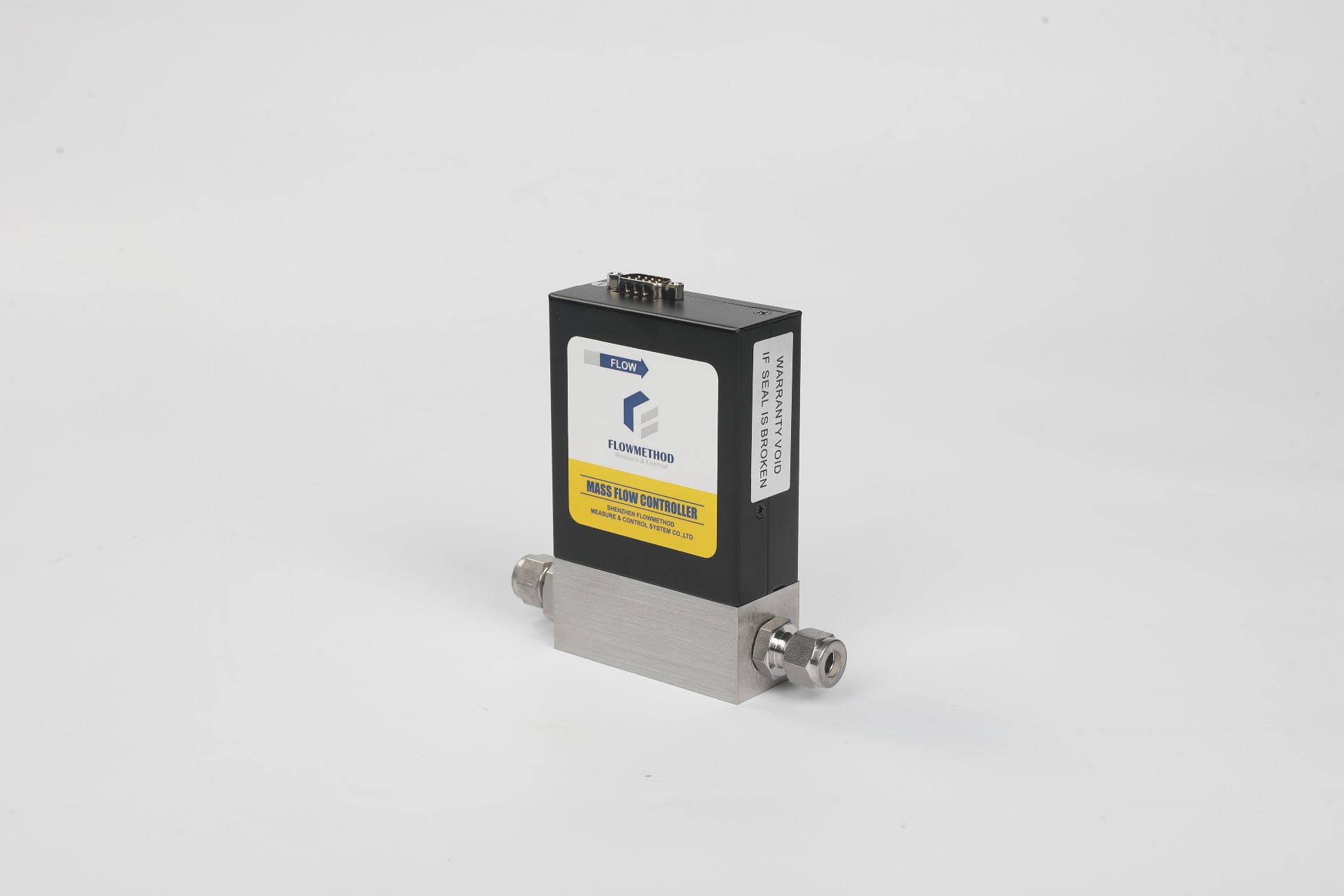
“How much does a gas mass flow controller cost?” cannot be answered meaningfully without its configuration. Range, interface, display, gas compatibility, calibration and custom requirements all affect the price. Compare complete configurations rather than a price per unspecified instrument.
1. Flow band
The selection bands on this website are 0–10, 10–50, 50–200 and 200–1000 SLPM, on a nitrogen-equivalent basis. Higher flows may require different valve and sensor arrangements. Select the band and ordered calibration range for the actual process minimum, normal and maximum flow.
Oversizing can increase cost while making the relative accuracy at low flow less favorable. Convert a different process gas to the nitrogen-equivalent basis before selecting its band.
2. Analog or digital: look beyond the connector
Analog versions use 0–5 V or 4–20 mA for compatible PLCs or display instruments. Digital -D models support RS485 / Modbus RTU and the agreed analog options. Digital communication can provide remote readings and controller commands, depending on the model and software. Do not assume features from the presence of a digital port alone.
The instrument price is only part of the cost. A few existing analog channels may make analog integration economical. Many instruments may require more PLC or DAQ modules and substantial wiring. A shared RS485 bus may reduce that hardware cost. Compare the complete instrument-and-control-system configuration.
3. Integrated display or external readout
A CM-series integrated-display model combines local readings and keypad operation with remote interfaces. It may avoid a separate desktop display. A no-display model leaves readout and control to external equipment.
Inside an equipment cabinet, an unseen LCD may provide little value if a PLC already handles operation. On a desktop or test bench, local display and keypad access can be convenient without a computer. Pay for a display where someone will actually use it. Meter versions provide readings but do not set or regulate flow.
4. Gas and operating conditions
Wetted-material and seal requirements change with the medium. Corrosive, condensing, high-pressure or unusually low-pressure service can require a different configuration and validation. Evaluate the operating value of a correctly matched system, not just the purchase-price difference.
5. Accuracy and calibration
The accuracy class, calibration gas, flow points and special test conditions affect work and cost. Confirm the full-scale basis and what calibration records are supplied with the quotation.
Higher accuracy is not always necessary. If a process only needs a less demanding limit, a tighter specification may add cost and lead time without useful benefit. Match the ordered specification to the actual process.
6. Custom requirements
A nonstandard range, material, interface, software function, protection requirement or installation arrangement can require additional design and testing. Custom work is not automatically prohibitively expensive, but its scope, validation, price and schedule must be agreed separately.
7. Eight items to prepare for a quotation
| Item | Information to supply |
|---|---|
| 1. Gas | Name/composition; corrosive, humid or condensing constituents |
| 2. Flow | Minimum, normal and maximum actual use; standard conditions |
| 3. Pressure | Inlet and outlet ranges, including vacuum or backpressure |
| 4. Function | Active flow control, or measurement only |
| 5. Signals | 0–5 V / 4–20 mA, or RS485 / Modbus RTU |
| 6. Display | Integrated local display or an external system |
| 7. Installation | Fitting size, orientation and available space |
| 8. Quantity and schedule | Units required and delivery date |
Ask shortlisted suppliers to quote against the same configuration, including whether reports, cables, fittings and power equipment are included. Process tubing is not included in the configurations described on this website.
8. Five supplier checks
Verify applicable credentials, unit-specific calibration records, options for agreed application validation, delivery and support commitments, and the supplier's actual product/design capability. If sample testing is desired, ask whether it is available rather than assuming a free trial is standard. Put important commitments into the order or contract.
The price of an MFC is the price of its configuration. Set the range correctly, choose signals and display for actual use, then compare like-for-like quotations.
For selection, installation or technical enquiries, contact Flowmethod: Mr. Dou, +86 180 3818 3381; doufeijin@hotmail.com. See Contact for the full contact list.