
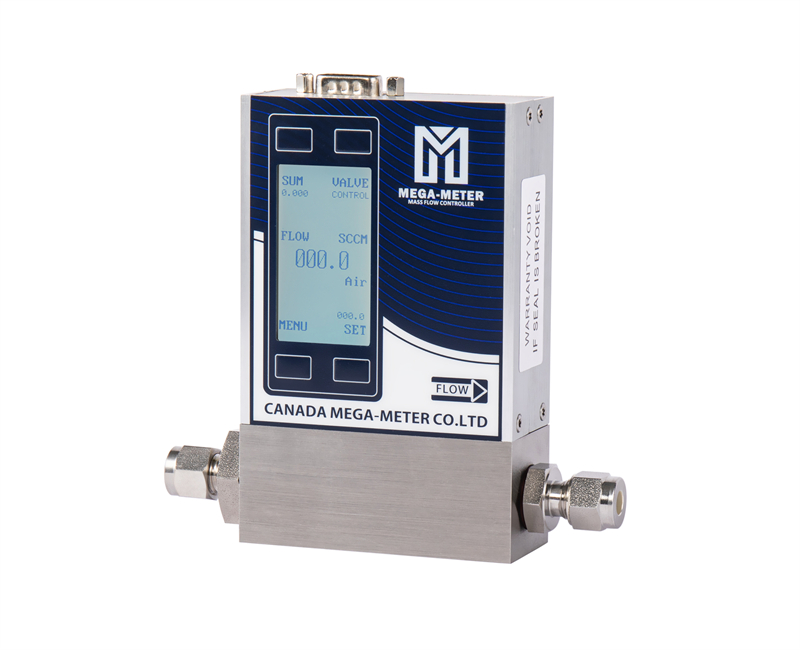
“Integrated display or separate readout?” is a frequent question when selecting a gas mass flow instrument. Display arrangement alone does not establish accuracy. Compare the actual measurement specifications; the practical decision usually starts with where the instrument is installed and where the operator will read it.
1. Define the two arrangements
Integrated display: the body combines the flow instrument with a local LCD and keypad, alongside supported analog and digital interfaces. CM-802LD and CM-803LD are examples of integrated-display controllers. Their meter counterparts provide local readings without flow-setting or valve-control functions.
No-display instrument with external readout: the body communicates with a separate display, PLC, DAQ or computer. Analog 0–5 V / 4–20 mA or RS485 / Modbus RTU can provide the external connection. Standard FL-series no-display models follow this arrangement.
Integrated operation adds convenience and functions; a separate readout arrangement avoids paying for a local display that the application may not use.
2. First question: where is the instrument installed?
Accessible on a bench, desktop or equipment panel: if operators need direct readings and adjustments, an integrated display can simplify commissioning and routine use.
Hidden inside a cabinet or equipment enclosure: if a PLC or external screen already handles operation, a local LCD may never be used. A no-display body is often more appropriate.
Ask where the operator will obtain the reading, not simply which model has the most functions.
3. Next question: analog or digital?
Consider the number of instruments and spare resources in the PLC, temperature controller or acquisition system.
One or two devices with available analog I/O: 0–5 V or 4–20 mA can provide straightforward integration using existing hardware. Confirm the required input channels and, for MFCs, output channels.
Many devices with compatible RS485 support: a Modbus RTU bus can reduce extra analog modules and wiring. Compare total system cost, including integration and update-rate requirements.
Some systems use analog channels for selected time-critical functions and a bus for the remaining monitoring points. Analog transmission speed must not be confused with the flow instrument's mechanical and measurement response time: the product response time shown on this website is 1 s, under the applicable specified conditions.
4. Environment and traceability
Moving the readout to a better-protected cabinet can reduce exposure of display electronics to heat, vibration or moisture. The instrument body must still meet its own environmental limits; removing the LCD does not make the body suitable for any environment.
Centralized digital software can record supported parameters such as flow and controller setpoints. Flow totalization and other functions depend on the instrument/software configuration and should be confirmed when ordering.
5. Four checks before selection
- Location: accessible operation point or hidden integration?
- Display: will a local screen actually be used?
- Communication: how many instruments, and what I/O or bus resources are already available?
- Range: use nitrogen-equivalent flow for the series selection and choose the ordered range for actual normal/minimum/maximum use.
6. Two common questions
Can an integrated-display instrument later connect to remote software? Many such models provide remote interfaces. Confirm the protocol and functions at the first purchase; later integration may require only additional compatible equipment rather than replacement of the instrument.
Will RS485 readings be delayed? Update time depends on the number of devices, baud rate, protocol and polling schedule. Check that the design meets the process requirement rather than assuming a bus has a fixed update time or every analog system is effectively instantaneous.
Choose local display where people use it, and external readout where a host system already manages the instrument. Match communication and range to the application rather than purchasing unused features.
For selection, installation or technical enquiries, contact Flowmethod: Mr. Dou, +86 180 3818 3381; doufeijin@hotmail.com. See Contact for the full contact list.