
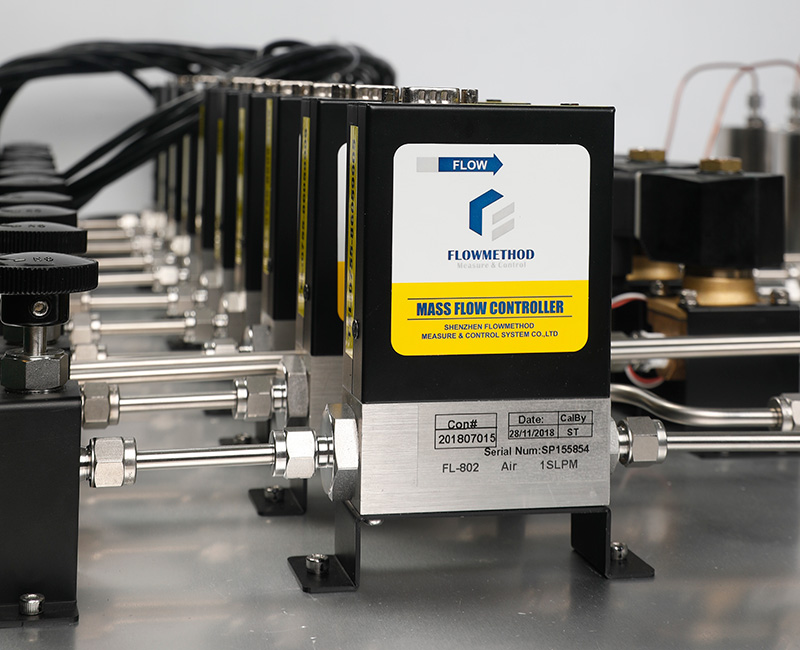
A flow instrument may spend months unused during production changes, project handover or spare-equipment rotation. Incorrect shutdown and storage can leave contamination in a fine sensor passage or a controller valve and cause zero drift or poor low-flow behavior when restarted.
1. Purge and replace the residual gas before shutdown
Residual moisture, corrosive gas or oil can affect the sensor, seals and valve during storage. Use a compatible dry purge gas, commonly nitrogen, and an approved discharge arrangement to replace the process gas before isolating the instrument.
A simple volume estimate helps plan the purge. A 2 m tube with 4 mm internal diameter contains about 25 mL:
π × (0.2 cm)² × 200 cm ≈ 25.1 cm³.
At 2 standard L/min, 15 seconds supplies about 500 standard mL, equivalent to roughly 20 of those volumes if both are compared at the same pressure/temperature basis. Instrument internal volume, operating pressure, mixing, dead spaces and adsorption can increase the purge needed. This estimate is not proof that the process gas has been removed.
Use a flow and duration approved for the instrument and medium. For hazardous or corrosive gases, verify the purge endpoint with an appropriate detector or validated procedure; do not use smell to decide that purging is complete.
2. Seal and protect after isolation
- Fit appropriate protective caps to the gas ports after safe depressurization. Open ports can draw in moisture and dust during temperature changes.
- Disconnect and secure cables after the approved electrical shutdown. Protect connectors, identify analog 0–5 V / 4–20 mA and digital RS485 wiring, and avoid mismatching them at restart.
- For a controller, return the command to zero and follow the specified gas isolation, depressurization and power-off sequence. Do not assume the control valve is an adequate safety isolation valve. A meter has no commanded flow-control valve.
3. Storage environment and periodic checks
Store in a dry indoor location at the permitted temperature, out of sunlight and away from solvent, acid or alkaline vapors. Secure the instrument so that its fittings are not mechanically loaded; the original protective packaging is useful.
The original article suggests a periodic check every three to six months. Use that only as a maintenance-planning example and follow the model's storage instructions. If powering up for inspection, establish the correct supply, warm-up and genuine no-flow conditions. Investigate a zero shift before correcting it or returning the instrument to service.
4. Three restart checks
- Inspect the body, ports and protective caps for condensation, corrosion or contamination before reconnecting.
- Restore pressure gradually according to the startup procedure; avoid sudden pressure shock.
- Warm up as instructed, leak-test the reconnected system and verify the relevant readings at the actual operating conditions. Compare command and feedback for an MFC; verify flow measurement for an MFM.
A controlled purge, capped ports, suitable storage and a documented restart process cost less than an avoidable repair or production stoppage. No particular storage duration alone guarantees that an instrument will remain within calibration.
For selection, installation or technical enquiries, contact Flowmethod: Mr. Dou, +86 180 3818 3381; doufeijin@hotmail.com. See Contact for the full contact list.